- Home Page
- | Galleries ▼
- | Blog ▼
- | About
- | Contact
Eurostarstruck: The Louvre, 3 October 2026
In choosing to allot our last full day in Paris to visiting The Louvre, we were not making a conscious decision to save the best for last. We were certain, however, that we would be spending hours among many of the most spectacular works of visual art ever created.
The world’s largest museum originated as a medieval fortress. Very little remains of the late 12th Century structure that Philip II erected. The Louvre has been expanded repeatedly throughout its history. It became the Musée du Louvre after the French Revolution. The Emperor Napoleon had it repaired and enlarged. Substantial alterations were made to it as recently as the 1980’s, when the glass pyramid that now occupies the courtyard was completed. The Musée du Louvre possesses half a million objects, with space for about 35,000 paintings, sculptures, artifacts and decorative wares to be displayed in its galleries at any one time.
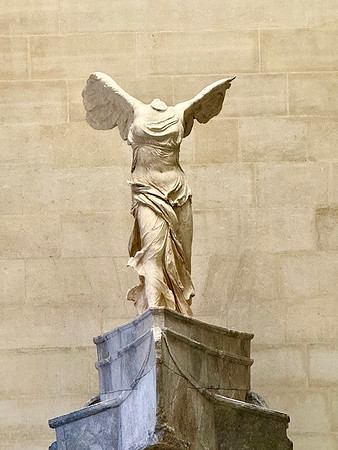

Even without her head and arms, the statue of the Winged Niké (or Victory) of Samothrace is striking.
This representation of the goddess is considered a masterpiece of Hellenistic sculpture. It dates from 190 BCE, yet it seems timeless to me. I was pleased to note that the Niké had not been denied her prominent place in the last round of reorganizations. The marble goddess is still positioned to greet the hordes of tourists and local art aficionados who fill The Louvre’s halls every day of the year.
The crowds were densest in the passages leading to the Mona Lisa. In the room where the painting hangs in a sort of cage, hundreds of people were packed together, all holding their cellphones aloft, as if they were participating in an ecstatic rite of pilgrimage. It was difficult to breathe, let alone look at the overwhelmingly famous Renaissance portrait. Adding to the outlandishness of the scene was the presence of four other paintings by Leonardo da Vinci in the adjacent Grande Galerie, all of them larger, brighter and more complex works than La Gioconda. Very few others were there, so Miri, HL and I could marvel at the other wondrous da Vincis at our leisure.
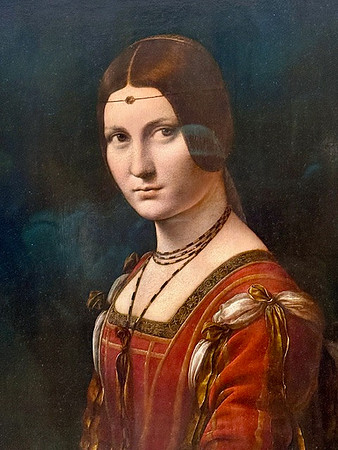
Da Vinci’s 1496 Portrait of an Unknown Woman is also known as La Belle Ferronnière. She is likely to have been the wife of a Milanese nobleman.
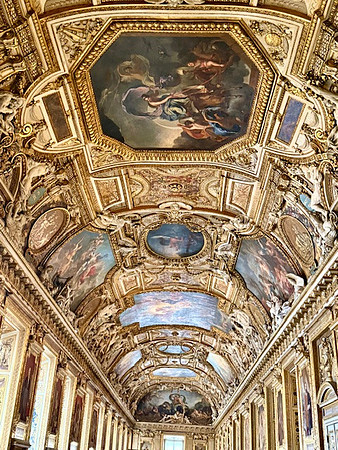
King Louis XIV commissioned the Apollo Gallery, or Galerie d’Apollon, in the 1660’s. He had the walls and ceiling decorated by the artists known collectively as The School of Fontainebleau, who had been responsible for embellishing the eponymous chateau. In 1887, the French Crown Jewels that had not been sold to fund the Third Republic were installed in showcases in the lavishly frescoed gallery. Many of them had belonged to Napoleon I and the Empress Josephine, and to Napoleon III and the Empress Eugenie.
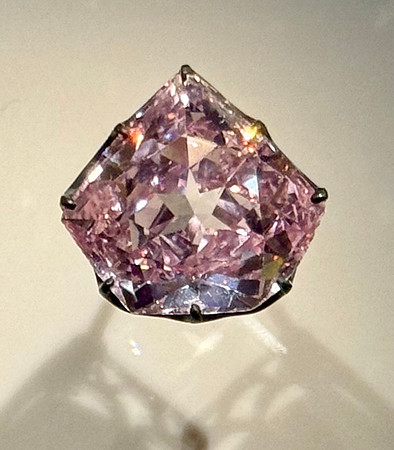
The Hortensia is a five-sided pinkish diamond weighing 21 carats, once the property of Louis XIV.
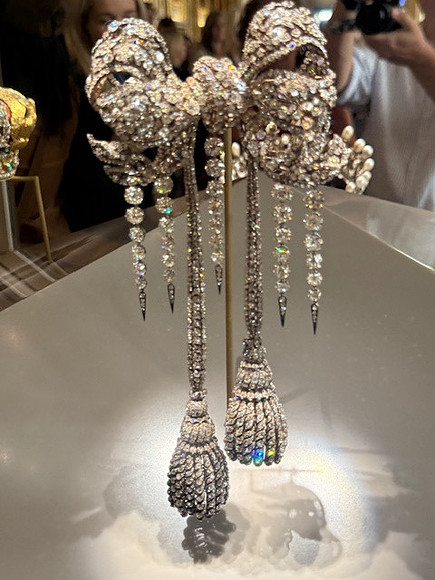
The Empress Eugenie wore this diamond bow brooch.
The Hortensia diamond and the elaborate diamond bow brooch, as well as six other precious pieces, were stolen from The Louvre on 19 October. Having beheld the jewelry so recently, I felt bereft when I heard about the
robbery. And I am sad that others henceforth will be denied the sight of these dazzling adornments.
With our exit from The Louvre, I closed my own Tale of Two Cities. We left for the airport on the following morning and bid Au Revoir to Paris. It is a pity that, a mere fortnight after our departure, all of France was forced to say Adieu to some of The Louvre’s most fabulous treasures. Had Miri not suggested that we view the French Crown Jewels, we should have missed our last chance to see them. The pieces were as magnificent as the vast museum’s security measures were inadequate.

Comments
|
January
February
March
April
May
(3)
June (3)
(1)
July (1)
August
September
October
November
(1)
December (1)
|
(7)
January (7)
(1)
February (1)
(1)
March (1)
April
May
(3)
June (3)
July
August
September
October
November
December
|
January
February
(2)
March (2)
(4)
April (4)
(5)
May (5)
(4)
June (4)
(5)
July (5)
(4)
August (4)
(4)
September (4)
(3)
October (3)
November
December
|
January
February
March
April
May
June
July
August
September
October
November
December
|
(1)
January (1)
(4)
February (4)
(5)
March (5)
(4)
April (4)
(4)
May (4)
(5)
June (5)
(4)
July (4)
(4)
August (4)
(5)
September (5)
(4)
October (4)
(4)
November (4)
(4)
December (4)
|
(4)
January (4)
(4)
February (4)
(1)
March (1)
April
(4)
May (4)
(5)
June (5)
(4)
July (4)
(3)
August (3)
(3)
September (3)
(1)
October (1)
November
December
|
(5)
January (5)
(4)
February (4)
(4)
March (4)
(4)
April (4)
May
(3)
June (3)
(4)
July (4)
(4)
August (4)
(4)
September (4)
(3)
October (3)
(4)
November (4)
(4)
December (4)
|
(3)
January (3)
(1)
February (1)
March
(1)
April (1)
May
(4)
June (4)
(4)
July (4)
(4)
August (4)
(1)
September (1)
October
November
(1)
December (1)
|
(4)
January (4)
(4)
February (4)
(4)
March (4)
(3)
April (3)
(2)
May (2)
(1)
June (1)
July
August
September
October
November
December
|