- Home Page
- | Galleries ▼
- | Blog ▼
- | About
- | Contact
Eurostarstruck: Kings, Ravens and Dragons of The Tower, 24 September 2025
We made our first Underground foray to the Tower of London. Here I must express my appreciation to HL for guiding our trio through the multiple Tube levels and subway lines so that we could ogle the Crown Jewels and marvel at the martial memorabilia of the English kings.
We were not, alas, allowed to photograph the Crown Jewels. Nor could we linger in front of the spectacular royal crowns, orbs and scepters. A moving pavement carried us past the most emblematic pieces, though slowly enough for us read the labels. The rooms were darkened so that the halogen lights seemed to set the gems ablaze. Videos featuring the history and creation of some of the best known jewels played in some parts of the exhibit, but I found them more of a distraction than an enhancement. We were wise to make the treasure rooms our first stop, as those draw increasingly large crowds throughout the day.
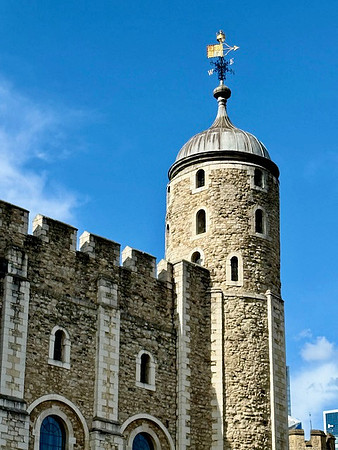

The White Tower has undergone numerous restorations since the original castle was built for William the Conqueror, the first Norman ruler of England, around 1080 CE. Once a royal residence, the fortress was used as a prison, storehouse and armor repository until relatively recently.
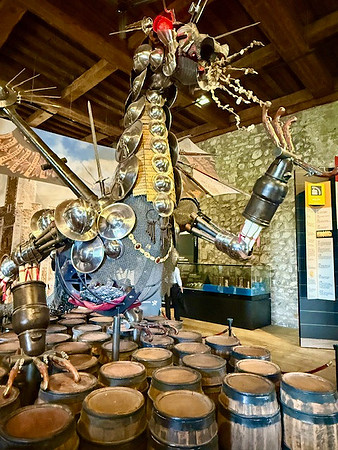
A fanciful modern denizen of The Tower was a dragon comprised of weapons from helmets and shields to flintlock pistols. One of the Tower’s chief curators commissioned the 15-foot tall creature from a firm of metal designers. This guardian of these (presumably empty) powder kegs was named Keeper, as was the official responsible for the stored armaments.
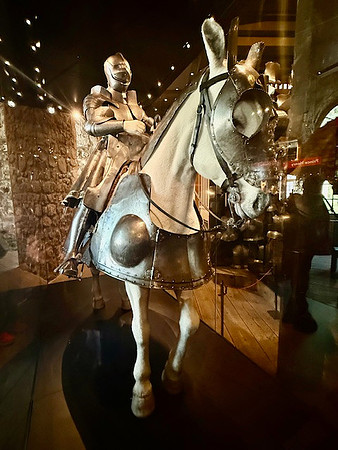 The White Tower houses an armory as well as The Line of Kings, a display begun in 1660 by Charles II to celebrate the Restoration of the House of Stuart to the English throne. Clad in elaborate armor, life-sized models of horses and their royal riders formed what is billed as Europe’s oldest continuously open visitor attraction. This is my picture of a suit of armor made for Henry VIII and his mount. The much-married monarch probably wore it when he rode at the head of his troops.
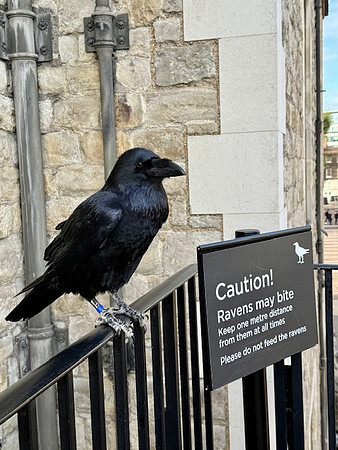
According to legend, as long as its ravens roost there, The Tower — and, by extension, England — will not fall. For the realm’s added protection, the birds’ wings are clipped. Perhaps that is the cause of their surliness.
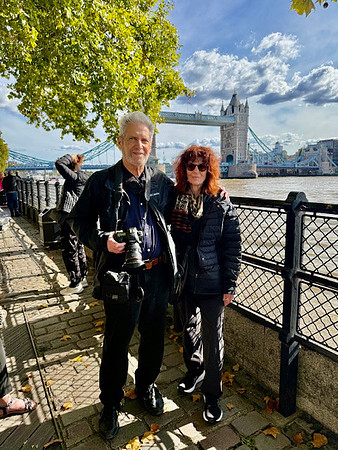
In unusually fine weather, we posed with Tower Bridge in the background, where it spans the Thames River. There had been no major public crossing near The Tower until the bridge was constructed late in the 19th Century, in the Gothic Revival style.

Comments
|
January
February
March
April
May
(3)
June (3)
(1)
July (1)
August
September
October
November
(1)
December (1)
|
(7)
January (7)
(1)
February (1)
(1)
March (1)
April
May
(3)
June (3)
July
August
September
October
November
December
|
January
February
(2)
March (2)
(4)
April (4)
(5)
May (5)
(4)
June (4)
(5)
July (5)
(4)
August (4)
(4)
September (4)
(3)
October (3)
November
December
|
January
February
March
April
May
June
July
August
September
October
November
December
|
(1)
January (1)
(4)
February (4)
(5)
March (5)
(4)
April (4)
(4)
May (4)
(5)
June (5)
(4)
July (4)
(4)
August (4)
(5)
September (5)
(4)
October (4)
(4)
November (4)
(4)
December (4)
|
(4)
January (4)
(4)
February (4)
(1)
March (1)
April
(4)
May (4)
(5)
June (5)
(4)
July (4)
(3)
August (3)
(3)
September (3)
(1)
October (1)
November
December
|
(5)
January (5)
(4)
February (4)
(4)
March (4)
(4)
April (4)
May
(3)
June (3)
(4)
July (4)
(4)
August (4)
(4)
September (4)
(3)
October (3)
(4)
November (4)
(4)
December (4)
|
(3)
January (3)
(1)
February (1)
March
(1)
April (1)
May
(4)
June (4)
(4)
July (4)
(4)
August (4)
(1)
September (1)
October
November
(1)
December (1)
|
(4)
January (4)
(4)
February (4)
(4)
March (4)
(3)
April (3)
(2)
May (2)
(1)
June (1)
July
August
September
October
November
December
|