- Home Page
- | Galleries ▼
- | Blog ▼
- | About
- | Contact
Eurostarstruck: Westminster Abbey, 25 September 2025
Westminster Abbey is one of the most solemn and fascinating tourist attractions in the United Kingdom. Though it was established as a Benedictine monastery over a millennium ago, the Abbey is not a museum but an active place of worship and pilgrimage. William the Conqueror was crowned there. King Edward the Confessor designated it a royal burial site in the 1100’s. In 1245, King Henry III replaced the older ecclesiastical edifice with what would become the soaring Gothic church which Miri, HL and I entered on Thursday morning. It is the site of regular Anglican services and, far less frequently, coronations. Yet it is primarily a mortuary palace for those whom the nation reveres.
I could understand how Christians would regard being interred inside the Abbey as a great honor. It has always seemed odd to me, however, that many of the illustrious dead were entombed in vaults below the floors so that living people must tread on a pavement of grave markers. Some of those stones are just memorial tributes, with their subjects buried elsewhere. Most, though, cover the caskets of men and women prominent in British history. And the floor burials continue to this day.
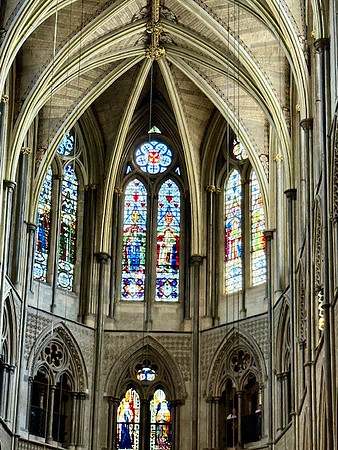

A series of memorial chapels branches out from the Abbey’s nave. They are the equivalent of nobles’ family cemetery plots, with marble effigies reclining rigidly on their tombs.

Sir Stephen Hawking, the brilliant theoretical physicist who was disabled by disease throughout much of his career, joined his predecessors in the scientists’ section of the floor.
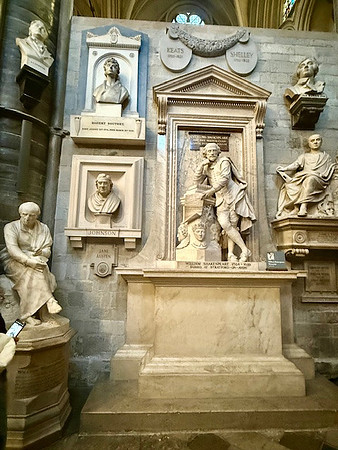
My favorite part of the Abbey was the Poets’ Corner. A statue of Shakespeare dominates one side, though The Bard’s bones are not beneath it. He was laid to rest in the churchyard of his family's parish in Stratford-upon-Avon.
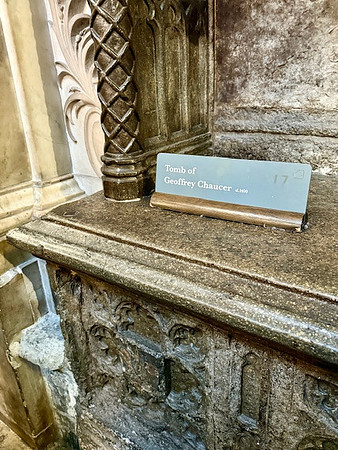 Geoffrey Chaucer, author of the medieval Canterbury Tales, actually was interred in this sarcophagus in 1400.
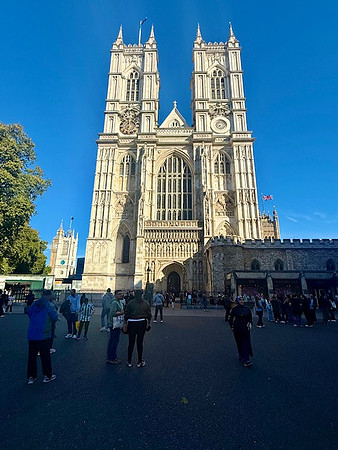
In the 18th Century, the west towers were added to The Abbey. After it sustained bombing damage in World War II, the Abbey was repaired and even improved. Somehow it appeared to me as if it rose all at once, an intricate manifestation of the persistent British devotion to King, Church and Country.

Comments
|
January
February
March
April
May
(3)
June (3)
(1)
July (1)
August
September
October
November
(1)
December (1)
|
(7)
January (7)
(1)
February (1)
(1)
March (1)
April
May
(3)
June (3)
July
August
September
October
November
December
|
January
February
(2)
March (2)
(4)
April (4)
(5)
May (5)
(4)
June (4)
(5)
July (5)
(4)
August (4)
(4)
September (4)
(3)
October (3)
November
December
|
January
February
March
April
May
June
July
August
September
October
November
December
|
(1)
January (1)
(4)
February (4)
(5)
March (5)
(4)
April (4)
(4)
May (4)
(5)
June (5)
(4)
July (4)
(4)
August (4)
(5)
September (5)
(4)
October (4)
(4)
November (4)
(4)
December (4)
|
(4)
January (4)
(4)
February (4)
(1)
March (1)
April
(4)
May (4)
(5)
June (5)
(4)
July (4)
(3)
August (3)
(3)
September (3)
(1)
October (1)
November
December
|
(5)
January (5)
(4)
February (4)
(4)
March (4)
(4)
April (4)
May
(3)
June (3)
(4)
July (4)
(4)
August (4)
(4)
September (4)
(3)
October (3)
(4)
November (4)
(4)
December (4)
|
(3)
January (3)
(1)
February (1)
March
(1)
April (1)
May
(4)
June (4)
(4)
July (4)
(4)
August (4)
(1)
September (1)
October
November
(1)
December (1)
|
(4)
January (4)
(4)
February (4)
(4)
March (4)
(3)
April (3)
(2)
May (2)
(1)
June (1)
July
August
September
October
November
December
|